
In absolute terms, both types of cars must cut emissions by about 28-29 g/km. But in percentage terms, the lighter 900-kg car must reduce emissions by 27 per cent, while the 1,500-kg car needs a 22 per cent cut. And the target becomes progressively stringent for both -- but, once again, the tightening is sharper for the 900-kg car than for the 1500-kg car.

'If the targets become unscientific and unjust, Then, just to meet CAFE-III regulation, a small car -- which produces a very low absolute carbon dioxide -- will have to be discontinued.'

Passenger vehicle sales in India touched a record high of 41.08 lakh units in 2023, growing by 8.3 per cent over the previous year driven by SUVs, which accounted for almost half of the total dispatches from manufacturers to dealers. The record sales have been achieved despite an increase in the average price of vehicles to Rs 11.5 lakh last year as compared to Rs 10.58 lakh in 2022. Market leader Maruti Suzuki, Hyundai Motor India, Tata Motors and Toyota Kirloskar Motor reported their best-ever annual sales in 2023.

The push given to rooftop solar installation in the Interim Budget ties in with its high rate of adoption in Tier-II and -III cities of India. If original equipment manufacturers (OEMs) in the automobile industry, government, and the solar sector are to be believed, in cities of Rajasthan, Gujarat, and Kerala, 45-50 per cent of electric-vehicle (EV) users are employing rooftop power to charge their vehicles. This is compared to the national average of 25 per cent, say industry sources.

Tata Motors will soon submit a detailed report on the upcoming manufacturing plant in Tamil Nadu's Ranipet district and a decision, on whether the facility will churn out passenger or commercial vehicles, will be taken by the company on the basis of market trends, state's industries minister TRB Rajaa said on Thursday. "They are keeping the options open, and market trends will determine it (the type of vehicles the plant will make). "They will quickly come up with a detailed report on that," Rajaa said.

Maruti Suzuki and Hyundai Motor India on Monday reported a dip in passenger vehicle dispatches to dealers in the domestic market last month as the companies tried to adjust vehicle inventory amid slowing demand. Maruti Suzuki India said it "calibrated supplies" to the dealers, aligning with the industry's retail sales projections amid India-Pakistan conflict and a dip in sales of entry-level cars.

Unveiled in December last year, the Altroz, which is the industry's first BSVI diesel-ready car. is also the first vehicle model based on the brand's Alfa platform and the second vehicle showing the Impact 2.0 design language. Besides Altroz, Tata Motors also launched the BSVI versions of Nexon, Tiago and Tigor.

While GST on ICE vehicles was brought down significantly, for electric cars it remained at 5 per cent.

'SUV is a very intensely fought category, unlike hatchbacks and cars.'

Contrary to information in the report, Tata Motors does not have any plans of 'de-emphasising' the Tata Indica, the statement said.

Automobile giant Tata Motors' shares were in demand on Wednesday as the stock rallied as much as 3.69 per cent to hit an intraday high of Rs 671.80 per share, before settling 3.18 per cent higher at Rs 668.45. By comparison, the BSE Sensex settled 0.10 per cent, or 72.56 points, lower at 74,029.76.
Tata Motors, India's leading CV manufacturer, may bring its pick-up trucks, a joint venture product with Thonburi of Thailand, to Indian shores.

Fada estimates that global supply chain headwinds like scarce availability of rare earth elements for electric vehicle components and geopolitical tensions may affect urban consumer sentiment in June as well.
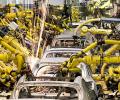
The sharp increase in commodity prices on account of the Russia-Ukraine war has put automakers in a fix. After the frequent price hikes in the current fiscal, manufacturers fear that any more price increases may further dent the already weak demand in certain segments. "We have taken several hikes and cannot immediately do it again. "We will have to closely watch the situation and act accordingly," said an official at an auto firm, declining to be identified. Even for companies like Tata Motors Passenger Vehicles, which has had a strong volume run and a robust order book, passing on the entire costs has been tough.

Nexon is the first sub-4 metre sports utility vehicle from Tata Motors' stable and is expected to give a tough competition to the likes of Maruti's Vitara Brezza and Ford's EcoSport.
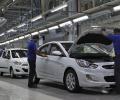
Multiple tailwinds for the automobile sector, including a cut in goods and services tax (GST) rates, are keeping analysts bullish on auto stocks from a long-term perspective, even as they see the rally running its course in the near term.

"My understanding is that the rules are weighted in favour of big cars, even though smaller cars emit fewer emissions per passenger, use less material, and consume less fuel," Bhargava said in an interview with Business Standard.
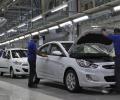
Leading automakers Maruti Suzuki, Hyundai and Tata Motors on Friday reported robust sales for February as demand for sports utility vehicles continued to remain strong. Mahindra & Mahindra, Toyota Kirloskar Motor and Honda Cars also witnessed higher vehicle dispatches to dealers last month. February turned out to be the third-best month for sales for the industry ever.

The small sports utility vehicle (SUV) segment - comprising models less than 4 metres in length - could witness the "maximum" growth among all categories in the coming months following the recent goods and services tax (GST) rate rationalisation, Tarun Garg, chief operating officer of Hyundai Motor India (HMIL), said.

Kerala has overtaken more industrialised states in personal electric vehicle adoption, driven by strong middle-class uptake, policy support, and charging infrastructure.

Given the better growth in JLR sales and improving domestic sales, nearly 90 per cent of the analysts covering the stock have a 'Buy' rating.

Although it has not announced the price bookings, sources say it could be in thousands.
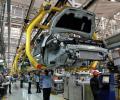
Auto parts exports from India may see a slight slowdown as US President Donald Trump's 25 per cent tariff could increase car prices for buyers by 8-25 per cent, thereby affecting demand, experts believe.

Overall, volume growth is likely to be in the range of 3-8 per cent for two-wheelers and 5-7 per cent for passenger vehicles owing to healthy demand from urban and rural areas and pending order books.

Tata Motors on Friday said it will hike the prices of its passenger vehicles, excluding the Nano, by up to Rs 36,000 from April 1, to offset rising input costs.

Leading automakers Maruti Suzuki, Hyundai and Tata Motors reported decline in wholesales in August as the companies curtailed vehicle dispatches amid drop in demand and to cut inventories at dealer level. Market leader Maruti Suzuki India said its total domestic passenger vehicle wholesales were at 143,075 units last month as compared to 156,114 units in the year-ago month, registering a dip of 8 per cent. Sales of mini segment cars, comprising Alto and S-Presso, declined to 10,648 units last month as against 12,209 units a year ago.

Tata Motors, Mahindra & Mahindra and Kia India on the other hand witnessed an increase in their market share based on the retail sales last fiscal. As per the Federation of Automobile Dealers Associations (FADA), the retail sales of country's largest carmaker Maruti Suzuki India rose to 14,79,221 units in 2022-23 fiscal, attaining a market share of 40.86 per cent. It had retailed 12,39,688 units in 2021-22 and grabbed a market share of 42.13 per cent.
The only silver lining in March's performance -- which otherwise dragged down the financial year's momentum -- was a 6 per cent year-on-year (Y-o-Y) growth compared to March of the previous year. This is largely due to incentives, festival-driven gains, and new launches.

'We will have multiple engine options -- electric vehicle and internal combustion engine in diesel and petrol.'

Automakers Maruti Suzuki, Mahindra & Mahindra and Audi India on Monday announced plans to hike prices of their passenger vehicles in January 2024 citing reasons, including cost pressure driven by overall inflation and increased commodity rates. Besides, Tata Motors and Mercedes-Benz India are mulling increasing the prices of their models from January. The country's largest carmaker Maruti Suzuki India, which sells a range of vehicles from entry-level small car Alto to multi-utility vehicle Invicto, priced between Rs 3.54 lakh and Rs 28.42 lakh (ex-showroom Delhi), on Monday said the price hike would vary from model to model.

With nearly 100 launches and unveils, the Bharat Mobility Global Expo 2025, held in Delhi from January 17 to 22, made one thing clear to automobile enthusiasts: Electric vehicles (EVs) are the way ahead for the Indian auto market for years to come.

China's covid crisis could provoke a raw material crunch for India's EV industry later this year.

The mini truck and passenger vehicle, which together crossed the 1-million sales mark in August, are already present in 24 countries.

Leading carmakers Maruti Suzuki and Hyundai on Thursday reported a dip in wholesales in July as companies reduced vehicle dispatches to dealers amid moderation in demand. Maruti Suzuki India said its total domestic passenger vehicle sales stood at 137,463 units in July against 152,126 units in the year-ago month, down 9.64 per cent.

If electric cars with a real range of more than 400 km are launched, the anxiety regarding the charging points will come down, and more people will buy EVs.

The entry level car, brainchild of Ratan Tata who envisaged giving a safer and affordable alternative to families riding on two-wheelers, received lacklustre response from the Indian consumer. Tata Motors to bid adieu to Nano from April 2020.
Starting January, the market is expected to welcome models like the Tata Punch 2025 which is expected to be around 6 lakh, Mahindra BE 07 EV around 29 lakh, Maruti WagonR Electric around 8.5 lakh, Toyota 3-Row SUV around 14 lakh, and Volkswagen Tera to be around 8 lakh.

Dealers said the discounts this March are higher than the same month in the previous year.

The growth momentum that started during the festival season is likely to sustain in the new year, reports Arindam Majumder.

For hatchbacks and sedans, offers range between Rs 40,000 and Rs 80,000 while SUVs and multi-purpose vehicles carry benefits exceeding Rs 1 lakh.
